After nearly seven years of focused research and development, Associate Professors Kartik Baruah and Parisa Norouzitallab at the Swedish University of Agricultural Sciences (SLU) are preparing to bring a breakthrough aquaculture innovation to the market. The result is CytoPrim™, a multi-functional nutraceutical solution designed to enhance resilience in aquaculture animals against both environmental and pathogenic stressors.
Supported by SLU Holding, the technology has recently been registered in the EU under the tradename CytoPrim™. The innovation aims to substantially improve animal health, welfare, and robustness while significantly reducing reliance on unsustainable chemotherapeutics in aquaculture production systems. Following extensive validation across multiple species, the launch is planned for 2026.
“This innovation represents a paradigm shift in how health, welfare, and disease prevention are addressed in aquaculture,” says Kartik Baruah. “Rather than responding to disease once it occurs, CytoPrim™ focuses on proactively building robust and resilient animals.”
Interdisciplinary Science as the Foundation
CytoPrim™ is the outcome of a close interdisciplinary collaboration between the two researchers. Kartik Baruah contributes expertise in fish nutrition, health, and physiology, while Parisa Norouzitallab brings advanced knowledge in epigenetics and trained immunity.
“Our collaboration creates added value that goes beyond individual disciplines,” says Baruah. “In simple terms, when we work together, one plus one becomes three.”
A Holistic Alternative to Antibiotics
Extensive experimental trials in a wide range of species, including salmonids such as Atlantic salmon, rainbow trout, and Arctic char, as well as crustaceans like Artemia and Penaeus vannamei, have demonstrated improved immune responses, increased stress tolerance, and clear indicators of enhanced animal welfare.
“The animals show improved behaviour, cope better with stress, and display increased resilience,” explains Parisa Norouzitallab. “CytoPrim™ is non-toxic and has demonstrated antimicrobial effects that outperform conventional antibiotics, indicating its potential as a viable alternative.”
Conventional aquaculture systems often rely heavily on antibiotics due to high disease pressure and stressful rearing conditions. CytoPrim™ offers a fundamentally different approach.
“We deliberately chose a holistic, nutraceutical-based strategy,” says Baruah. “The goal is to strengthen the animal’s own capacity to cope with stress and disease, rather than relying on treatment after problems arise.”
From Research Excellence to Practical Application
CytoPrim™ operates at the interface between nutrition and health and is based on carefully selected nutraceutical components with long-standing use in traditional human medicine across Asia, Europe, and Africa. Sustainability has been a guiding principle throughout development, from the responsible sourcing of ingredients to the scalability of production.
“We have a deep understanding of the biological effects of each individual component,” says Norouzitallab. “Equally important, we know how these components interact synergistically, and how delivery strategies can be optimised across species and developmental stages.”
Growing Global Interest
The innovation has already attracted strong interest from the global aquaculture sector. Companies in Europe and the Global South have expressed interest in testing CytoPrim™ in both temperate and tropical species. The innovators are regularly invited to present their work internationally, underlining the technology’s global relevance and commercial potential.
From Global Academic Journeys to Swedish Innovation
Originally from India and Iran, respectively, Kartik Baruah and Parisa Norouzitallab arrived in Sweden after more than a decade of education and research in Belgium.
“At the time, moving to Sweden was not a strategic choice,” says Baruah. “But in hindsight, it was a fortunate one. Sweden offers exceptional support for innovation, and SLU in general and SLU Holding in particular deserve special recognition.”
Norouzitallab agrees:
“SLU Holding has provided outstanding support throughout this journey. Their encouragement, strategic guidance, and long-term perspective have been instrumental.”
Research, Commercialisation, and the Next Generation
As CytoPrim™ moves closer to commercialisation, both innovators remain firmly committed to academia and to educating the next generation of young researchers, while actively collaborating with industry partners to bring the technology to market.
“Our ambition is to translate high-quality research into solutions that make aquaculture more sustainable, ethical, and economically viable,” says Baruah.
“It is deeply rewarding to help shape the careers of young scientists,” adds Norouzitallab. “We also want to acknowledge the many of our students who have contributed to these results.”
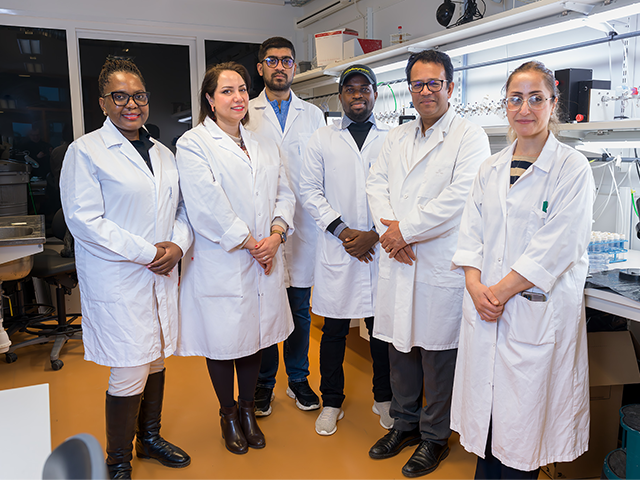
The research team. From right to left. Patience Chungu, Parisa Norouzitallab, Yamin Rahman, Arnold Ebuka Irabor, Kartik Baruah, Sheida Azizi Verki. Photo: Göran Ekeberg/Addlight
Looking ahead, they see strong opportunities at the intersection of academia and industry.
“As researchers, we can continue refining and expanding the technology,” says Baruah. “In the future, close collaboration with industry may also create opportunities to support industrial PhD positions.”
Reflecting on the long journey, Norouzitallab concludes:
“A human doctor may receive feedback from patients every day. For us, it took over seven years. But knowing that our research has led to an innovation with real-world impact makes every effort worthwhile.”
For more information
Read more about Parisa Norouzitallab´s research
Harnessing epigenetics to induce robustness in rainbow trout (EpiTrout)
Read more about Kartik Baruah´s research
Locally produced fish feed ingredients with multiple functions can boost sustainable aquaculture production