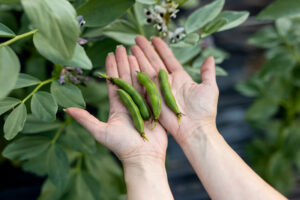
Tofu made from Swedish-grown faba beans could offer a new alternative to traditional soy-based products. Researchers at SLU have already demonstrated that it is possible, and a consumer study involving 102 participants has produced promising results. Now, the research will be taken further through DeLiS, where food science meets advanced technology and innovation expertise.
Tofu is usually associated with soybeans, which are largely imported into Sweden. But what if we could instead make tofu from faba beans grown on Swedish farmland?
This is the possibility being explored by Maud Langton, Professor at SLU, and her research group within the PAN Sweden research environment. In recent years, they have investigated how Swedish-grown legumes can be used to develop new plant-based foods.

Maud Langton, Professor at SLU, leads the research into how Swedish-grown faba beans can be used to develop new plant-based foods, including tofu. Photo: Jenny Svennås-Gillner, SLU.
“We started with a simple question: why not use Swedish-grown legumes to produce familiar and nutritious foods? We have faba beans that are rich in protein but are still used to a limited extent in food products. We wanted to explore whether they could be used to make something similar to tofu,” says Maud Langton.
A Swedish crop with great potential
Faba beans have several characteristics that make them an interesting crop for future food production. They thrive in the Swedish climate, are rich in protein and dietary fibre and, like other legumes, can fix nitrogen from the air. This reduces the need for nitrogen fertilisers.
However, there are also challenges. Faba beans contain compounds that need to be addressed through appropriate processing to improve their nutritional quality. Their proteins also behave differently from soy proteins when processed into food products. To make tofu, the proteins need to form a cohesive gel that gives the product its structure. Since faba beans have a different protein composition and contain more starch than soybeans, the result is not quite the same.
“We have demonstrated that it is possible to make tofu-like products from faba beans, but the texture can be firmer and less elastic than traditional tofu. The flavour can also be slightly beany. That is why we are investigating how the production process affects the product’s structure, flavour and texture,” says Maud.
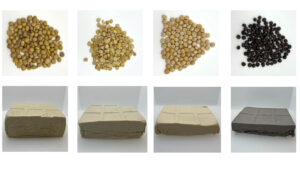
Soybeans, faba beans, yellow peas and grey peas (top row), and tofu-like products made from each of these legumes (bottom row). Photo: Jing Lu.
Promising results from consumer study
Researcher Jing Lu has spent the past two years developing the product. Among other things, the research team has investigated how faba bean proteins behave during processing and how different production methods affect the product’s structure and quality.
The team recently conducted a consumer study involving 102 Swedish participants. They were asked to evaluate tofu-like products made from soybeans and various Swedish-grown legumes. The results showed that consumers were positive about faba bean tofu, particularly when they were informed that the raw material was grown in Sweden. But origin is not everything. For a new product to succeed, it also needs to taste good.

Over the past two years, Jing Lu has been working on developing tofu from Swedish-grown faba beans. Her research provides new insights into how the production process affects the product’s structure and quality. Photo: Jenny Svennås-Gillner, SLU.
“Even if a food product is both nutritious and sustainable, it will be difficult to succeed if its taste and texture do not meet consumer expectations. That is why we need to combine food science and technology research with sensory studies and consumer testing,” says Jing Lu.
From the laboratory to the supermarket shelf
Developing a product in the laboratory is one thing. Producing it on a larger scale, at a reasonable cost and with consistent quality, is quite another.
For Swedish faba bean tofu to become a commercial product, the researchers need to improve its flavour and texture, make the production process more efficient and investigate how it performs at a larger scale. There is also a need for a reliable supply of Swedish-grown faba beans of consistent food-grade quality, as well as solutions for shelf life, food safety and packaging.
This is where DeLiS comes in.
DeLiS, Deeptech and Food in Collaboration, is a collaborative project led by SLU Holding together with the Swedish University of Agricultural Sciences (SLU), Örebro University, Örebro University Holding and Uppsala Innovation Centre (UIC). It represents a first step towards a national collaboration platform bringing together food research, advanced technology and innovation expertise.
The aim is to help more promising research findings develop into sustainable innovations, new products and companies. By connecting researchers from different disciplines with innovation advisors and industry representatives, DeLiS aims to foster new collaborations and provide support along the journey from research to market. The tofu project is one of the first concrete examples of how this can work.
New opportunities when research disciplines come together
Maud sees several opportunities in combining food research with expertise from other fields. Advanced microscopy and techniques for analysing material properties could provide a better understanding of how protein structures affect texture. Fermentation could open up new ways to improve flavour and nutritional value, while engineering expertise is essential for developing the production process on a larger scale.
Through DeLiS, the research team hopes to establish new connections with both technology specialists and food companies, and eventually explore the possibilities for pilot-scale production.
“We have built up extensive knowledge about Swedish legumes, protein properties and food processing. But moving from laboratory research to commercial production requires expertise from several different fields. I hope DeLiS can help us find new collaborations and take the next step in development,” says Jing Lu.
The dream of Swedish tofu on supermarket shelves
For Maud, the research is about more than developing a single product. She sees great potential in using Swedish-grown legumes in a wider range of food products. This could create new opportunities for farmers and food producers while also reducing dependence on imported protein ingredients.
“What is particularly exciting is the possibility of turning a Swedish-grown crop into a new food product that can actually reach consumers. It would be fantastic to one day see tofu made from Swedish faba beans on supermarket shelves,” says Maud.
The hope is that the knowledge gained from the tofu project can also be used to develop many more food products based on Swedish raw materials.
“The Swedish tofu project is DeLiS’s first reference project, and there are many more exciting research findings at SLU with the potential to be developed further. Through DeLiS, we want to help researchers establish new collaborations, both with other researchers in advanced technology and with people who have innovation expertise or other relevant skills. We are currently planning a series of workshops to create more opportunities for these kinds of connections and collaborations. We look forward to sharing more about this in the future,” says Mats Wiktorsson, Innovation Advisor at SLU Holding.
Om DeLiS
DeLiS is the first step towards a national collaboration platform connecting research in food science and advanced technology. The aim is to help more research findings develop into sustainable innovations, new business opportunities and companies in the food sector.
Through collaboration between SLU Holding, the Swedish University of Agricultural Sciences (SLU), Örebro University, Örebro University Holding and Uppsala Innovation Centre (UIC), new pathways are being created from research to innovation and market.
The project builds on the PAN Sweden research environment and is funded by the Swedish Agency for Economic and Regional Growth (Tillväxtverket) through the European Regional Development Fund for Central Sweden, Formas and Region Uppsala.
Read more about DeLiS