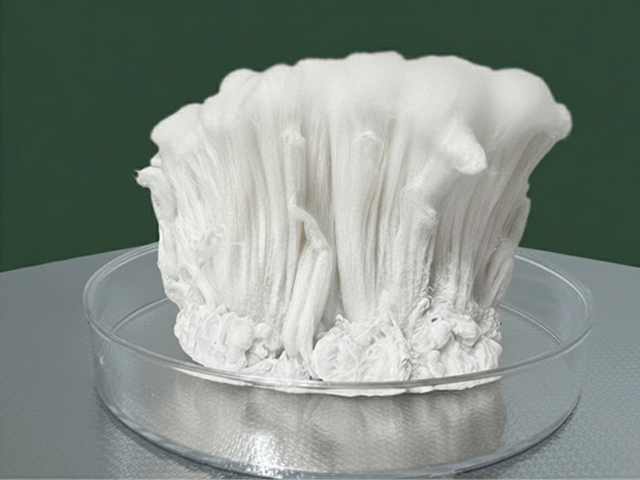
Our food production inevitably creates sidestreams. However, material such as potato peelings and carrot tops, which are often thrown away, can instead be utilised and turned into resources for new innovations and circular thinking. Seaqure labs’ website describes this as “Changing the way we feed our food”. The start-up company converts sidestreams from the food industry into a fungi-based, sustainably produced fish feed.
“The sustainable and unique aspect of our innovation is the fact that the feed is made from sidestreams from the food industry, rather than using new raw materials in the production process,” says Mohsen Parchami.
His journey from new arrival in Sweden as a master’s student to head of research and entrepreneur at Seaqure labs has taken less than ten years.
During his doctoral studies at the University of Borås, Mohsen focused on ways of utilising malt residues left over from the brewing of beer. In the liquid fermentation process, the filamentous fungus Rhizopus delemar formed mycelium, comprising thin cell threads growing on the malt waste. In parallel with this, Mohsen conducted research on the degradation processes in respect of the malt waste fibres, with the aim of making the nutrients even more accessible to the fungus.
The work then focused on finding uses the resulting biomass. In Borås, Mohsen met fellow researcher Sajjad Karimi, and together they developed the concept regarding for the fungi-based fish feed that Seaqure labs is now testing.
“Another sustainability aspect is that the feed can be produced either directly in connection with the sidestreams or close to the fish farms. The process itself also gives rise to very little residue,” says Mohsen Parchami.
Turning research and innovations into businesses and production processes may seem overwhelming. Through Chalmers, however, Mohsen Parchami and Sajjad Karimi were able to connect with then students Albin Frick and Johan Henriksson, who as part of their degree project at Chalmers School of Entrepreneurship were aiming to develop an innovation project into a business over the course of a year.
“Sajjad and I were coming up with the ideas, but we didn’t know how to turn them into a business. As scientists, we easily got lost in details that weren’t really relevant to anyone else, while at the same time failing to see some of our own strengths. We needed help structuring our business concept in order that others could see the potential. That’s where Albin and Johan at Chalmers School of Entrepreneurship came in, providing us with invaluable assistance when it came to chiselling out the concept. They were also able to put us in touch with others who could help us further.”
From PhD student to postdoc to entrepreneur
The plans went well, but after Mohsen completed his doctorate, things came to a halt for a while. On the one hand, he needed to extend his residence permit in Sweden, and in addition he lacked the funding to start a business. Mohsen enjoyed a couple of instructive years as a postdoc at SLU in Umeå, before the quartet from the University of Borås and Chalmers School of Entrepreneurship in Gothenburg were able reunite around their common vision of a sustainable and locally produced feed ingredient. Seaqure labs was founded in 2024, with SLU Holding as one of the investors.
The company’s production process still uses filamentous fungi, but the malt residues from brewing have been replaced with vegetable waste from the food industry, and the liquid fermentation has been replaced by solid state fermentation. The fungi strain has long been approved and used for the production of both human and animal food. For example, it is used to produce tempeh.
“The company is undergoing a scale-up phase. There is definitely interest – that much is clear – and we hope to have a finished product on the market in about a year.”
Up until now, batches totalling a couple of hundred kilograms of fungi-based feed ingredient have been produced, and then successfully tested as fish feed. Trials regarding the use of the fungus in chicken feed and pet food are also currently in progress.
“The biggest challenge at the moment is to increase the protein content of the fungi-based feed, in order to match the high protein content of more traditional fish feed, which often comprises fishmeal,” says Mohsen
From a position of security to daring to take the risk
SLU Holding has provided extensive and crucial support along the way. Mohsen Parchami greatly appreciates the concept of innovation offices, which support scientists who want to approach industry.
“Because it was scary at first! As a doctoral student, for example, I felt a sense of security being surrounded by supervisors, lecturers and examiners. There was always someone to ask, someone who had your back and who you could get feedback from. As an entrepreneur, you have to be able to take on all the challenges that await you, large and small, much more independently.”
Now, however, he has completed the transition from life as an academic to life as an entrepreneur. There are other companies that have a similar approach, but Mohsen can see a future where Seaqure labs has established itself internationally as a pioneering business.
“Our innovation has enormous potential, and I felt right from the start that it would progress from the research lab to production within a company. Becoming an entrepreneur is not always a simple and straightforward path, but it provides interesting experiences. And I believe that daring to take the risk is a good thing!”
Read more about Seaqure Labs.